PakAlumni Worldwide: The Global Social Network
Digital Pakistan 2023: Technology Transforming Women's Lives in Rural Pakistan
Growing access to smartphones and Internet connectivity is transforming the lives of women in rural Pakistan. They are acquiring knowledge, accessing healthcare and finding economic opportunities. A recent UNDP report titled "DigitAll: What happens when women of Pakistan get access to digital and tech tools? A lot!" written by Javeria Masood describes the socioeconomic impact of technology in Pakistan in the following words:
"The world as we know it has been and is rapidly changing. Technology has proven to be one of the biggest enablers of change. There has been a significant emphasis on digital trainings, tech education, and freelancing in the last several years especially during the pandemic, through initiatives from the government, private and development sectors. Covid-19 acted as a big disrupter and accelerated the digital uptake many folds. In Pakistan, we saw the highest number of digital wallets, online services, internet-based services and adaptability out of need and demand".
 |
| Pakistani Women in South Punjab. Photo by Shuja Hakim UNDP Pakistan |
Digital Transformation:
The report cites the example of Ayesha Abushakoor from Zawar Wala in South Punjab who is a Quran teacher. She is teaching students remotely in and outside Pakistan. She uses digital wallets to receive payments. The same report also cites the case of Samina, from Muzafargharh, who is getting training online to start a livestock business. Another woman Mujahida Perveen from UC Pega in Dera Ghazi Khan is managing her thyroid disease by watching YouTube videos.
Telehealth is helping more women access healthcare in remote areas of Pakistan. Startups like Sehat Kahani are employing women doctors who work from home to provide healthcare services. Sehat Kahani was founded by Dr. Sara Khurram and Dr. Iffat Zafar who raised seed funding of US$ 500,000 in 2018, followed by a pre-series of $1 million in March 2021.
Expansion of Digital Services:
The year 2022 was a very rough year for Pakistan. The nation was hit by devastating floods that badly affected tens of millions of people. Macroeconomic indicators took a nose dive as political instability reached new heights. In the middle of such bad news, Pakistan saw installation of thousands of kilometers of new fiber optic cable, inauguration of a new high bandwidth PEACE submarine cable connecting Karachi with Africa and Europe, and millions of new broadband subscriptions. Broadband penetration among 140 million (59% of 236 million population) Pakistanis in the 15-64 years age group reached almost 90%. This new digital infrastructure helped grow technology adoption in the country.
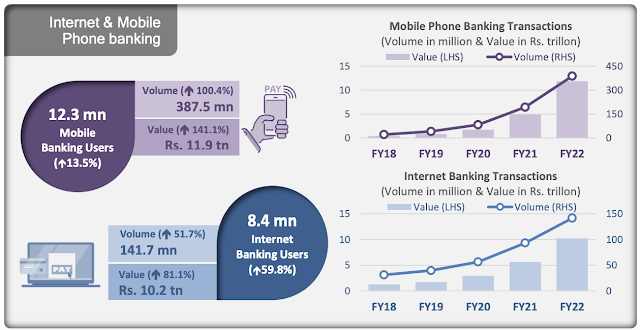 |
| Internet and Mobile Phone Banking Growth in 2021-22. Source: State Bank of Pakistan |
Fintech:
Mobile phone banking and internet banking grew by 141.1% to Rs. 11.9 trillion while Internet banking jumped 81.1% to reach Rs10.2 trillion. E-commerce transactions also accelerated, witnessing similar trends as the volume grew by 107.4% to 45.5 million and the value by 74.9% to Rs106 billion, according to the State Bank of Pakistan.
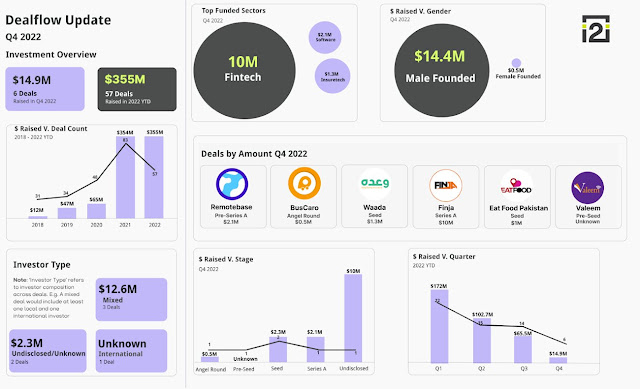 |
| Pakistan Startup Funding in 2022. Source: i2i Investing |
Fintech startups continued to draw investments in the midst of a slump in venture funding in Pakistan. Fintech took $10 million from a total of $13.5 million raised by tech startups in the fourth quarter of 2022, according to the data of Invest2Innovate (i2i), a startups consultancy firm. In Q3 of 2022, six out of the 14 deals were fintech startups, compared to two deals of e-commerce startups. Fintech startups raised $38 million which is 58% of total funding ($65 million) in Q3 2022, compared to e-commerce startups that raised 19% of total funding. The i2i data shows that in Q3 2022, fintech raised 37.1% higher than what it raised in Q2 2022 ($27.7 million). Similarly, in Q2 2022, the total investment of fintech was 63% higher compared to what it raised in Q1 2022 ($17 million).
 |
| E-Commerce in Pakistan. Source: State Bank of Pakistan |
E-Commerce:
E-commerce continued to grow in the country. Transaction volume soared 107.4% to 45.5 million while the value of transactions jumped 75% to Rs. 106 billion over the prior year, according to the State Bank of Pakistan.
 |
| Pakistan Among World's Top 10 Smartphone Markets. Source: NewZoo |
PEACE Cable:
Pakistan and East Africa Connecting Europe (PEACE) cable, a 96 TBPS (terabits per second), 15,000 km long submarine cable, went live in 2022. It brought to 10 the total number of submarine cables currently connecting or planned to connect Pakistan with the world: TransWorld1, Africa1 (2023), 2Africa (2023), AAE1, PEACE, SeaMeWe3, SeaMeWe4, SeaMeWe5, SeaMeWe6 (2025) and IMEWE. PEACE cable has two landing stations in Pakistan: Karachi and Gwadar. SeaMeWe stands for Southeast Asia Middle East Western Europe, while IMEWE is India Middle East Western Europe and AAE1 Asia Africa Europe 1.
 |
| Mobile Data Consumption Growth in Pakistan. Source: ProPakistan |
Fiber Optic Cable:
The first phase of a new high bandwidth long-haul fiber network has been completed jointly by One Network, the largest ICT and Intelligent Traffic and Electronic Tolling System operator in Pakistan, and Cybernet, a leading fiber broadband provider. The joint venture has deployed 1,800 km of fiber network along motorways and road sections linking Karachi to Hyderabad (M-9 Motorway), Multan to Sukkur (M-5 Motorway), Abdul Hakeem to Lahore (M-3 Motorway), Swat Expressway (M-16), Lahore to Islamabad (M-2 Motorway) and separately from Lahore to Sialkot (M-11 Motorway), Gujranwala, Daska and Wazirabad, according to Business Recorder newspaper.
Mobile telecom service operator Jazz and Chinese equipment manufacturer Huawei have commercially deployed FDD (Frequency Division Duplexing) Massive MIMO (Multiple Input and Output) solution based on 5G technology on a large scale in Pakistan. Jazz and Huawei claim it represents a leap into the 4.9G domain to boost bandwidth.
 |
| Pakistan Telecom Indicators November 2022. Source: PTA |
 |
| Pakistan's RAAST P2P System Taking Off. Source: State Bank of Pakistan |
Broadband Subscriptions:
Pakistan has 124 million broadband subscribers as of November, 2022, according to Pakistan Telecommunications Authority. Broadband penetration among 140 million (59% of 236 million) Pakistanis in 15-64 years age bracket is 89%. Over 20 million mobile phones were locally manufactured/assembled in the country in the first 11 months of the year.
 |
| Bank Account Ownership in Pakistan. Source: Karandaaz |
 |
| Financial Inclusion Doubled In Pakistan in 5 Years. Source: Karandaaz |
Documenting Pakistan Economy:
Pakistan's unbanked population is huge, estimated at 100 million adults, mostly women. Its undocumented economy is among the world's largest, estimated at 35.6% which represents approximately $542 billion at GDP PPP levels, according to World Economics. The nation's tax to GDP ratio (9.2%) and formal savings rates (12.72%) are among the lowest. The process of digitizing the economy could help reduce the undocumented economy and increase tax collection and formal savings and investment in more productive sectors such as export-oriented manufacturing and services. Higher investment in more productive sectors could lead to faster economic growth and larger export earnings. None of this can be achieved without some semblance of political stability.
Related Links:
2021: A Banner Year For Tech Startups in Pakistan
Pakistan Projected to Be World's 6th Largest Economy By 2075
Digital Pakistan 2022: Broadband Penetration Soars to 90% of 15+ Population
Working Women Seeding a Silent Revolution in Pakistan
Socioeconomic Impact of New Infrastructure in Rural Pakistan
Pakistan Gets First Woman Supreme Court Judge
Pakistan at 75
Growing Presence of Pakistani Women in Science and Technology
Riaz Haq's Youtube Channel
Riaz Haq
Pakistan Sees Sudden 6x Jump in Credit Card ATM Transactions
By Business Desk | Published Jul 26, 2026 | 8:06 pm
https://propakistani.pk/2026/07/26/pakistan-sees-sudden-6x-jump-in-...
Pakistan’s credit card market recorded its largest-ever quarterly growth, with the number of cards in circulation jumping by 900,000 in just three months, according to Gallup Pakistan’s Digital Analytics Dashboard based on data from the State Bank of Pakistan (SBP).
The total number of credit cards increased from 2.2 million in FY25 to 3.1 million in Q1 FY26 (July-September 2025), up by 44 percent.
The addition exceeds the total net growth recorded over the previous six years, during which the credit card base rose from 1.6 million to 2.2 million.
The surge coincided with a sharp rise in credit card usage. SBP data shows the value of credit card transactions at ATMs increased nearly sixfold during the same quarter.
Despite the unprecedented jump, no major bank, fintech, or financial institution publicly announced a large-scale credit card issuance campaign during the period.
The increase could be linked to a major card issuance, a regulatory reclassification of certain card products, or the launch of new credit-based payment products. SBP hasn’t revealed anything on this so far.
Debit cards continue to dominate Pakistan’s payment landscape, accounting for around 90% of the country’s 61.3 million payment cards, while credit cards represent about 4 percent.
-----------
Credit card growth in Pakistan is experiencing a sudden shift, jumping from a stagnant base of 2.2 million to 3.1 million cards in late 2025, driven by rising fintech adoption and digital banking integrations. Despite this growth, total penetration remains exceptionally low relative to the country's population. [1, 2, 3, 4]
Market Statistics and Recent Surge
Base Expansion: Stagnated around 1.6 million to 2.2 million cards between FY20 and FY25, before a single-quarter jump to 3.1 million in Q1 FY26 (July–September 2025). [1]
Transaction Activity: ATM credit card transaction values spiked nearly 6x during the Q1 FY26 surge, confirming active utilization rather than passive issuance. [1]
Overall Market Share: Debit cards still heavily dominate, making up roughly 90% of Pakistan’s 61.3 million total payment cards. [1]
Jul 26
Riaz Haq
New Connectivity Plan Proposed to Boost Internet in Remote Areas
https://www.techjuice.pk/new-connectivity-plan-proposed-to-boost-in...
The federal government wants to bridge the digital divide. Federal Minister for Economic Affairs Ahad Cheema recently chaired a crucial meeting. He discussed the proposed National Connectivity Plan. Minister for IT & Telecom Shaza Fatima Khawaja and several senior officials also attended this session. Primarily, the meeting focused on expanding high-speed internet access. The government wants to connect villages, remote areas, and small towns. Consequently, this move will unlock massive new economic opportunities across the country.
A Connectivity Plan to Empower Freelancers & Digital Professionals
Currently, slow and unreliable internet creates major hurdles for remote workers. Therefore, Federal Minister Ahad Cheema highlighted the government’s top priority. Authorities aim to facilitate freelancers, e-commerce entrepreneurs, and other digital professionals living in remote regions. The government will take all necessary measures to ensure affordable, high-speed internet services. As a result, every citizen can fully participate in the growing digital economy.
Furthermore, the session highlighted the critical importance of 5G infrastructure. Next-generation fiber-to-the-home (FTTH) networks will also drive national economic growth. Ultimately, these crucial upgrades will create jobs and foster nationwide digital inclusion.
Ambitious Infrastructure Targets
Pakistan is already experiencing strong momentum in digital development. Officials noted steady growth in FTTH subscriptions, which currently stand at 2.8 million. Moreover, the country boasts a robust fiber footprint of 234,000 kilometers. The current infrastructure includes 5.1 million house passes and six operational submarine cables.
To build upon this solid foundation, the government outlined highly ambitious national targets. The plan seeks to expand the infrastructure to 10 million house passes. Additionally, the government aims to raise average fixed broadband download speeds to 85 Mbps. Authorities also plan to increase tower fiberization to 60 percent. Consequently, these specific efforts aim to secure the country a spot among the world’s top 50 countries for broadband performance.
Strategic Reforms & Tax Relief
The meeting placed a massive emphasis on digital affordability. Participants actively considered targeted tax relief for internet users living in remote areas. This key decision will significantly expand digital participation.
Additionally, officials discussed several strategic reforms. The government plans to abolish right-of-way fees. Authorities will also launch a single-window approval portal and introduce district-level licensing. Furthermore, the plan makes fixed broadband connectivity mandatory across all public institutions, schools, and health facilities.
To ensure swift execution, the government will finalize the National Connectivity Plan expeditiously through comprehensive stakeholder consultation. Cheema stressed the need for a highly structured and sequenced approach. The government will prioritize essential regulatory reforms and enforce clear operator obligations. Moreover, officials will link financial support directly to verified performance milestones. This strategy will accelerate nationwide fiber deployment. At the same time, it will successfully safeguard public resources and ensure long-term commercial viability.
Jul 31
Riaz Haq
USF Connects 16.2m People, Deploys 10,400km OFC in Five Years.
The projects expanded broadband access across thousands of underserved areas. Fibre deployment also connected 947 previously unserved
https://www.techjuice.pk/usf-connects-16-2m-people-deploys-10400km-...
The Universal Service Fund (USF) has expanded voice and broadband access to more than 16.2 million people. The projects covered over 9,400 underserved and unserved mauzas during the last five fiscal years.
The figures were shared by Minister for Information Technology and Telecommunication Shaza Fatima Khawaja. She provided the details in a written reply to the National Assembly.
During FY2022-26, USF projects delivered voice and broadband data services across more than 9,400 mauzas. The programme also helped bring broadband to areas where telecom operators lacked a strong business case.
USF also expanded coverage along more than 1,000 kilometres of unserved roads. These included sections of national highways and motorways. The projects also covered eight tourist destinations and around 50 kilometres of access routes.
The fund deployed more than 10,400 kilometres of optic fibre cable (OFC) during the same five-year period. This work connected 947 unserved tehsil headquarters, union councils and towns.
Since its launch, USF has reached more than 38.4 million people across over 22,100 mauzas. It has also covered more than 2,500 kilometres of previously unserved road segments.
The fund has connected eight tourist destinations and about 50 kilometres of access routes. Its total OFC deployment has also crossed 18,300 kilometres since inception.
USF was established under Section 33(A)(1) of the Pakistan Telecommunication (Re-organization) Act, 1996. Its main goal is to extend telecom services to rural, remote and underserved communities.
The programme initially focused on voice and basic data services through 2G networks. It later expanded to high-speed broadband through 3G and 4G networks.
The government said better connectivity is also supporting education, healthcare and emergency services. It is helping improve financial inclusion, e-governance and access to economic opportunities.
The ministry said USF remains important in areas where commercial telecom deployment is difficult. It will continue targeting unserved and underserved communities through broadband and fibre projects.
yesterday