PakAlumni Worldwide: The Global Social Network
Raast Aims to Create Pakistan's Unified Digital Payments Infrastructure
Pakistan's central bankers have taken the plunge into the world of digital payments with their own offering: Raast. It aims to create an instant low-cost payment system that can seamlessly and securely connect government entities, a variety of banks, including microfinance banks (MFBs), electronic money institutions (EMIs) and State Bank authorized payment service providers (PSPs) like 1Link and NIFT which may choose to take advantage of it. Currency and coins in circulation account for about 43% of Pakistan's total money supply. The introduction of Raast is part of the government's effort to modernize and document the nation's cash-based informal economy. Undocumented economy poses a serious threat to the country because it creates opportunities for criminal activities and tax evasion. Digital financial services will also promote e-commerce in Pakistan.
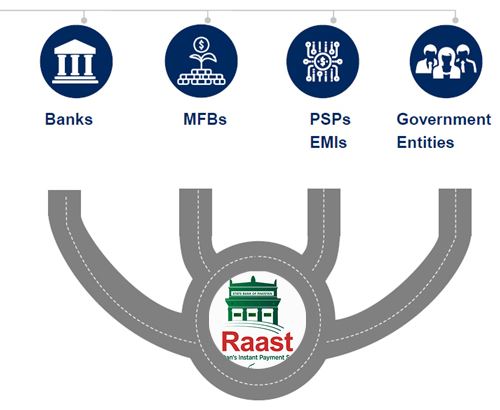 |
| Raast Digital Payment System. Source: State Bank of Pakistan |
Raast Digital Payments:
Raast is a system of digital payment infrastructure. It is essentially a pipe that is intended to connect government and financial institutions with consumers and merchants with each other to process payments instantly at very low cost.
Raast will be boosted by Pakistan government's decision to use it to pay salaries, pensions and pay welfare recipients under Benazir Income Support and Ehsaas Emergency Cash programs.

State Bank of Pakistan intends to demonstrate Raast's usefulness by first processing government payments to individuals, including government employees and Ehsaas welfare beneficiaries, before expanding it for business applications. SBP’s plan is to start person-to-person (P2P) payments using just the phone numbers in Q3/2021 and then bring merchants on board with QR codes by Q1/2022.
Pakistan's Sadia Zahidi Leads WEF Gender Equity Effort
Brothers From Rural Pakistan Teaching AI to American High Schoolers
Pakistan's Computer Services Exports Jump 26% Amid Coronavirus Lockdown
Pakistan Gig Economy Among World's Fastest Growing
Digital BRI and 5G in Pakistan
Pakistan's Demographic Dividend
Pakistan EdTech and FinTech Startups
State Bank Targets Fully Digital Economy in Pakistan
Campaign of Fear Against CPEC
Fintech Revolution in Pakistan
E-Commerce in Pakistan
The Other 99% of the Pakistan Story
FMCG Boom in Pakistan
Belt Road Forum 2019
Fiber Network Growth in Pakistan
Riaz Haq's Youtube Channel
Riaz Haq
Pakistan’s retail landscape has undergone a significant digital transformation, with nearly 90% of retail payments now processed through digital channels, according to the State Bank of Pakistan’s (SBP) latest Quarterly Payment Systems Review for Q3 FY25.
------
Digital payments surge as mobile apps and Raast drive growth in third quarter
SBP reports 12% rise in retail transaction volumes and 22% growth in mobile-based payments
https://profit.pakistantoday.com.pk/2025/06/25/digital-payments-sur...
-----------
The State Bank of Pakistan (SBP) has reported continued growth in the country’s digital payment landscape, with a 12% increase in retail transaction volumes and an 8% rise in value during the third quarter of FY25. According to SBP’s Quarterly Payment Systems Review, total retail transactions reached 2.4 billion, valued at PKR 164 trillion, with 89% conducted through digital channels.
Mobile apps, including banking apps and e-wallets, processed 1.7 billion transactions worth PKR 27 trillion—up 16% in volume and 22% in value. Mobile banking app users rose 7% to 22.6 million, while e-money and branchless wallet users increased to 5.3 million (up 12%) and 68.5 million (up 6%) respectively.
E-commerce transactions climbed 40% in volume to 213 million and 34% in value to PKR 258 billion, with digital wallets accounting for 94% of the total. In-store POS transactions reached 99 million, worth PKR 550 billion, processed by over 140,000 merchants. QR code payments also grew, with 21.7 million transactions totalling PKR 61 billion.
SBP’s own platforms, Raast and RTGS, played a key role. Raast processed 371 million transactions worth PKR 8.5 trillion this quarter, bringing cumulative volume since launch to 1.5 billion and value to PKR 34 trillion. RTGS handled PKR 347 trillion in large-value payments across 1.5 million transactions.
The central bank credited the growth to its digital finance strategy and collaborative efforts by banks, fintechs, and payment providers, reaffirming its commitment to financial inclusion and payment system efficiency.
------------------
State Bank of Pakistan (SBP) has released its Quarterly Payment Systems Review for Q3 FY25,
providing summary on the payment systems, and presenting notable changes in the digital
payment landscape of the country.
https://www.sbp.org.pk/psd/pdf/PS-Review-Q3FY25.pdf
Jun 26, 2025
Riaz Haq
Jul 16, 2025
Riaz Haq
https://www.thefastmode.com/technology-solutions/47881-veon-subsidi...
VEON announced that its subsidiary JazzCash has onboarded its 1 millionth Raast QR-enabled merchant, marking a major milestone in Pakistan’s journey toward a cashless and digitally inclusive economy.
Raast is Pakistan's national instant payment system – a digital payments infrastructure launched by the State Bank of Pakistan in 2021. Raast enables interoperability across Pakistan’s financial sector, empowering merchants by accelerating the use of digital payment tools such as QR codes to advance digital financial inclusion in the country.
With one million Raast QR enabled merchants, JazzCash powers Pakistan’s largest digital payment acceptance network, digitizing everyday commerce across corner shops, micro-entrepreneurs, retailers and online businesses alike.
Kaan Terzioglu, VEON CEO, and Aamir Ibrahim, JazzWorld CEO and JazzCash Chairman, onboarded Behbud Crafts today in Islamabad. The merchant is a retail outlet operated by Behbud Association, a pioneering non-profit organization dedicated to empowering women through vocational training, education, and sustainable livelihoods.
JazzCash serves a registered customer base of 58 million and has processed more than PKR 15 trillion in transaction value in 2025 – roughly USD 53 billion, or the equivalent of 13% of Pakistan’s GDP. Through its growing network of merchants, QR payments, digital lending, and integration with Raast, JazzCash is helping formalize Pakistan’s economy while creating new opportunities for entrepreneurs, including women-led enterprises.
15 hours ago